
Learn how a PoE injector works, when it is the right choice, and how it compares with a PoE switch for modern network deployments.
Power over Ethernet (PoE) has become a standard technology for powering IP cameras, wireless access points, VoIP phones, and other network devices through a single Ethernet cable. While PoE switches are widely used, not every network requires replacing an existing switch.
In many cases, a PoE injector provides a simple and cost-effective way to add PoE capability without changing the existing network infrastructure.
This guide explains what a PoE injector is, how it works, and when it is the right solution for your network.
What Is a PoE Injector?
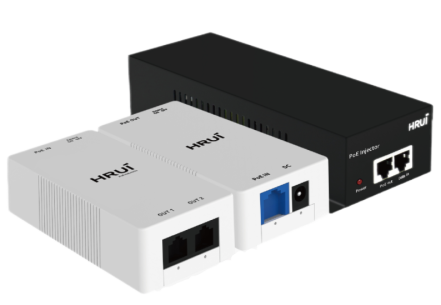
A PoE injector, also known as a Power over Ethernet injector, is a device that combines electrical power and Ethernet data into a single network cable. It enables a standard,
non-PoE switch or router to power PoE-compatible devices without replacing existing networking equipment.
Typical powered devices include:
■ IP Cameras
■ Wireless Access Points (AP)
■ VoIP Phones
■ IoT Devices
■ Video Intercom Systems
How Does a PoE Injector Work?
A PoE injector sits between the network switch and the powered device.
The process is straightforward:
1. A non-PoE switch sends Ethernet data to the injector.
2. The injector adds electrical power to the Ethernet cable.
3. The cable carries both power and data to the powered device.
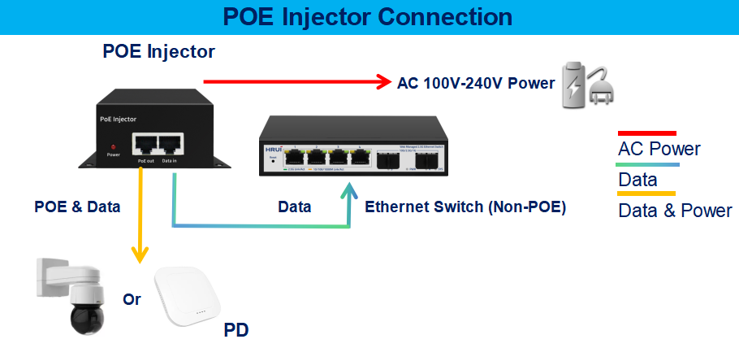
For IEEE 802.3af/at/bt compliant injectors, the injector first performs a detection and power-classification process to confirm that the connected device supports PoE before supplying power. This protects non-PoE devices from accidental damage.
PoE Injector vs. PoE Switch
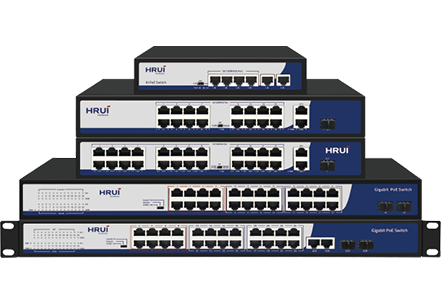
Although both devices deliver power over Ethernet, they are designed for different deployment needs.
| Feature | PoE Injector | PoE Switch |
| PoE Ports | Usually 1 | Multiple |
| Existing Switch Required | Yes | No |
| Best For | Adding PoE to one or a few devices | New or large PoE deployments |
| Initial Investment | Lower | Higher |
| Network Expansion | Limited | Highly scalable |
If only a few PoE devices need to be added to an existing network, a PoE injector is often the more economical solution. For larger deployments with many powered devices, a PoE switch offers centralized power management and easier expansion.
When Should You Use a PoE Injector?
A PoE injector is an ideal choice in several common scenarios:
Upgrade an Existing Network
If your current Ethernet switch does not support PoE, an injector allows you to power compatible devices without replacing the switch.
Small Deployments
For installations with one or two IP cameras or wireless access points, a PoE injector provides a simple and practical solution.
Reduce Upgrade Costs
Replacing an entire switch solely to support a few PoE devices may not be cost-effective. An injector can significantly reduce deployment costs while delivering the required functionality.
Common PoE Standards
Choosing the correct injector depends on the power requirements of the connected device.
| IEEE Standard | Maximum Power | Typical Devices |
| IEEE 802.3af | 15.4 W | VoIP Phones, Basic IP Cameras |
| IEEE 802.3at (PoE+) | 30 W | PTZ Cameras, Wi-Fi Access Points |
| IEEE 802.3bt (PoE++) | 60–90 W | Wi-Fi 6/7 APs, Industrial Devices, High-Power Cameras |
All IEEE PoE standards are backward compatible, allowing newer injectors to support many lower-power PoE devices.
Standard PoE vs. Passive PoE Injectors
Not all PoE injectors operate in the same way.
Standard (Active) PoE Injectors
■ IEEE 802.3af/at/bt compliant
■ Automatically detect compatible devices
■ Supply power only after successful negotiation
■ Recommended for most enterprise and commercial networks
Passive PoE Injectors
■ No automatic detection
■ Output a fixed voltage continuously
■ Designed only for devices that specifically support passive PoE
Using a passive injector with incompatible equipment may damage connected devices, so compatibility should always be verified before deployment.
How to Choose the Right PoE Injector?
Before purchasing a PoE injector, consider the following factors:
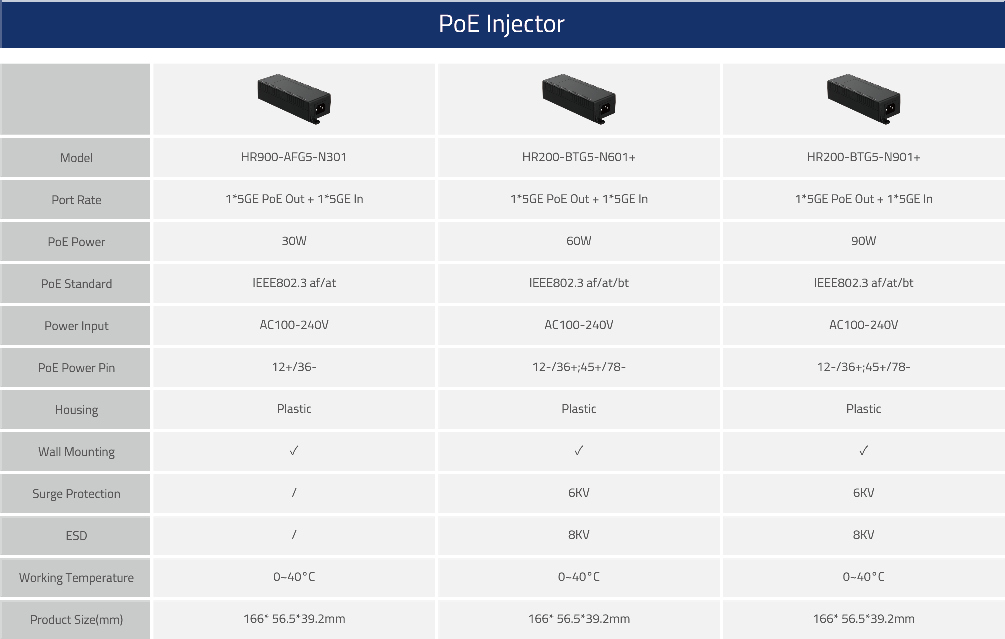
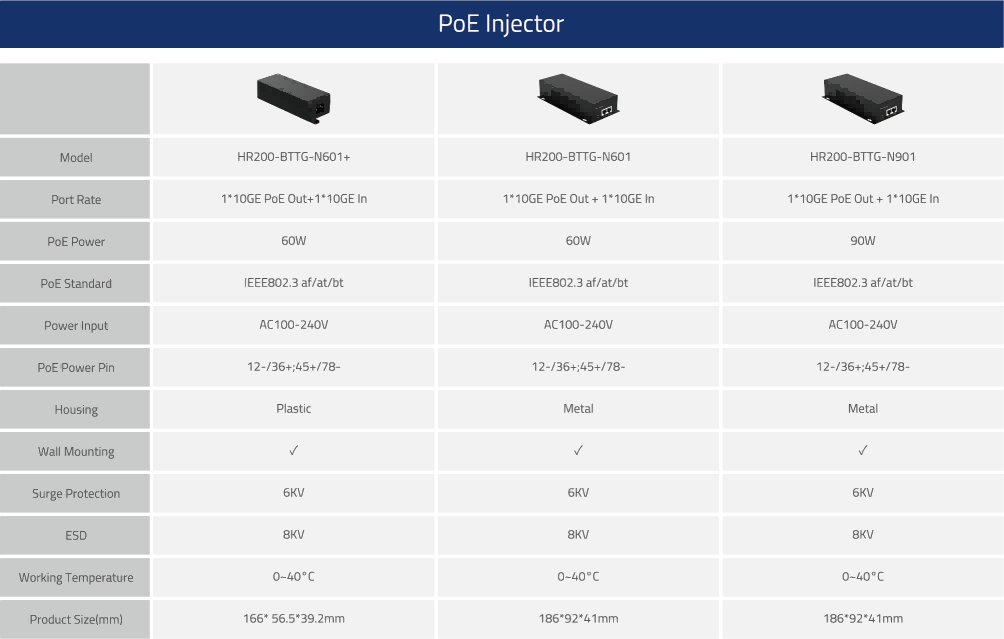
PoE Standard – Select IEEE 802.3af, 802.3at, or 802.3bt according to device power requirements.
Network Speed – Ensure support for Fast Ethernet, Gigabit, 2.5G, 5G, or 10G if required.
Power Output – Match the injector's output to the connected powered device.
Future Expansion – Higher-power, multi-gig injectors can better support future network upgrades.
A PoE injector provides a simple and cost-effective way to add Power over Ethernet capability to an existing non-PoE network. It enables both power and data to be delivered over a single Ethernet cable, eliminating the need for additional power outlets while supporting devices such as IP cameras, wireless access points, VoIP phones, and other IEEE 802.3af/at/bt compliant powered devices.
For small and medium-sized deployments, a PoE injector provides an efficient balance between flexibility, performance, and investment.For larger installations with many powered devices, a dedicated PoE switch may be the better long-term solution.Selecting the right PoE standard, power level, and network speed will help ensure reliable operation and support future network growth.
Selecting the right PoE standard, power level, and network speed will help ensure reliable operation and support future network growth.