

AI-powered machine vision is moving beyond simple inspection tasks. In modern factories, cameras and sensors are increasingly used for defect detection, process monitoring, worker safety, and automated decision-making. As these applications become more data-intensive, the industrial network connecting cameras, edge systems, and control equipment becomes part of the performance equation.
So, what does an industrial Ethernet network need to handle AI-powered machine vision?
Higher Bandwidth at the Edge
Machine vision systems can generate continuous streams of high-resolution image and video data. When multiple cameras operate simultaneously, a traditional 1G connection may become a constraint, particularly when image data is processed or transferred at the edge.
The required Ethernet speed depends on camera resolution, frame rate, compression, and the number of connected devices. For higher-throughput applications, 2.5G, 5G, or 10G Ethernet can provide additional capacity between cameras, edge computing systems, and aggregation switches.
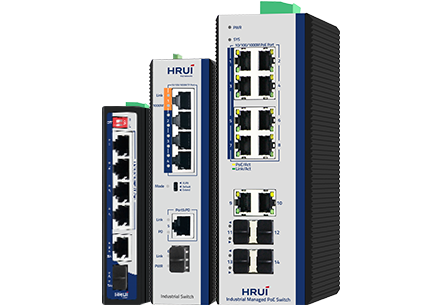
This makes the access switch an important part of the machine vision architecture:
Industrial Cameras → PoE Switch → Edge Computing → Industrial Network
Does AI Machine Vision Require PoE?
Not necessarily, but PoE can simplify camera deployment by carrying both power and data over a single Ethernet cable. This is particularly useful when cameras are distributed across production lines, warehouses, or other industrial environments.
The switch should be selected according to the camera's power requirements, total PoE budget, port speed, and environmental conditions. For higher-power devices, PoE+ or higher-power PoE technologies may be required.
Why Do Latency and Reliability Matter?
Machine vision is often connected to real-time production processes. Delays or intermittent connectivity can affect how quickly image data reaches an edge system or control application.
For this reason, industrial Ethernet design should consider more than bandwidth. Low and predictable latency, network redundancy, and rapid fault recovery can be important in applications where continuous data transmission is required.
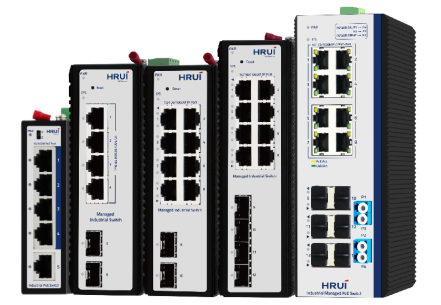
Managed industrial switches can support functions such as VLAN, QoS, ring redundancy, and traffic monitoring to help organize and protect machine vision traffic.
Designing the Network for Industrial AI
There is no single Ethernet specification for every AI-powered factory. Network requirements depend on the cameras, computing architecture, production process, and environmental conditions.
A practical design should evaluate:
■ Port speed: 1G, 2.5G, 5G, or 10G based on traffic requirements
■ PoE budget: sufficient power for connected cameras and devices
■ Uplinks: adequate capacity between access and aggregation layers
■ Redundancy: ring or dual-path architectures where required
■ Industrial protection: temperature range, surge protection, and power redundancy
As AI moves closer to the factory floor, machine vision is becoming a networking challenge as well as a computing challenge. A well-designed industrial Ethernet infrastructure provides the bandwidth, power, and reliability needed to connect cameras with the systems that turn visual data into production decisions.