



Network downtime can disrupt business operations, industrial automation, and security systems. Ethernet switch redundancy helps improve network reliability by providing alternative communication paths when a link or network component fails.
For enterprise and industrial networks, choosing the right redundancy mechanism is essential for maintaining connectivity and reducing service interruptions.
What Is Ethernet Network Redundancy?
Network redundancy uses alternative links or paths to maintain connectivity when a primary connection fails. Instead of relying on a single network path, a redundant design provides another route for traffic.
Common approaches include redundant uplinks, dual-homed connections, and ring network topologies. The appropriate design depends on network architecture, recovery requirements, and switch capabilities.
RSTP vs. ERPS: What Is the Difference?
Rapid Spanning Tree Protocol (RSTP), defined by IEEE 802.1w and incorporated into IEEE 802.1Q, helps prevent Layer 2 switching loops while enabling a redundant topology to recover after certain link failures.
Ethernet Ring Protection Switching (ERPS), standardized by ITU-T G.8032, is designed specifically for Ethernet ring networks. It uses ring protection mechanisms to restore connectivity after a failure, with recovery performance depending on the implementation and network conditions.
Key differences:
■ RSTP: Suitable for Layer 2 networks with redundant links and tree-based forwarding topologies.
■ ERPS: Designed for ring-based Ethernet networks requiring coordinated protection switching.
Both mechanisms help improve network resilience, but they are not interchangeable in every topology. Selection should be based on the network design and the protocols supported by the switches.
Key Benefits of Ethernet Switch Redundancy
Reduced downtime: Alternative paths can help restore connectivity when a link fails.
Improved network resilience: Redundant connections reduce dependence on a single physical link.
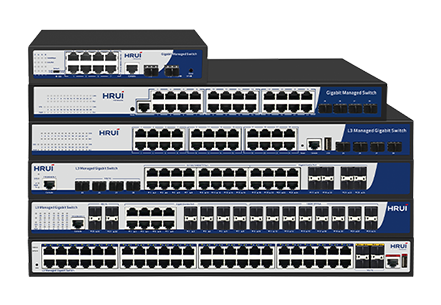
Flexible network design: Managed Ethernet switches can support different redundancy approaches for enterprise and industrial applications.
More reliable operations: Properly designed redundancy helps maintain connectivity for applications such as IP surveillance, industrial monitoring, and business communications.
Redundancy does not eliminate every point of failure. Switch power supplies, upstream equipment, configuration errors, and other shared components must also be considered.
How to Choose a Switch with Network Redundancy
Before selecting a managed or industrial Ethernet switch, consider these factors:
■ Protocol support: Verify whether the switch supports RSTP, ERPS, or another required redundancy protocol.
■ Topology compatibility: Ensure the protocol matches the planned network architecture.
■ Recovery requirements: Evaluate acceptable interruption time and confirm actual recovery performance.
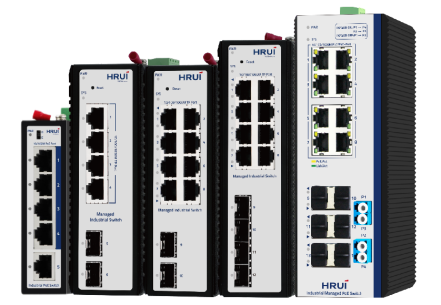
■ Environmental requirements: For industrial applications, check operating temperature, power design, and installation conditions.
■ Management capabilities: Consider configuration, monitoring, and fault diagnosis features.
Ethernet switch redundancy is an important part of designing reliable enterprise and industrial networks. By selecting an appropriate topology and supported protocol, network designers can reduce the impact of link failures and improve service continuity.
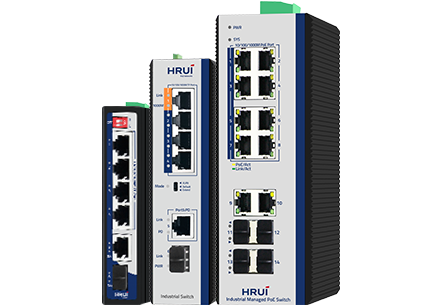
HRUI offers Ethernet switching solutions for various networking applications. Explore our managed and industrial Ethernet switches to identify a solution that meets your network redundancy and connectivity requirements.